Sir David Attenborough once said, "Reptiles and amphibians are sometimes thought of as primitive, dull and dimwitted. In fact…they can be lethally fast, spectacularly beautiful, surprisingly affectionate and very sophisticated.”
We are fortunate to have several reptiles and amphibians that call The Lorraine Cherry Nature Preserve their home. Rarely noticed by most visitors, they are nonetheless a vital part of the ecosystem. Here is some information about some of the reptiles and amphibians you are most likely to encounter in the preserve.
Anoles
Reptiles include turtles, lizards, snakes, and alligators. So far we have not seen any alligators in the nature preserve (!), but all the other groups are represented.
The commonest reptiles in the nature preserve (and probably also in your gardens) are two species of anole lizard. Anoles are related to iguanas but are much smaller. Our native Green Anole (Anolis carolinensis) is typically bright lime green but can change to tan or brown to blend in with its background. This species has a relatively long snout, and the lower eyelid is often blue. Males will sometimes extrude a pinkish dewlap (a flap of skin on the throat) as a courtship or threat display. The non-native Brown Anole (Anolis sagrei) is an introduced species from the Caribbean and is considered an invasive. Brown anoles are never green but can be different shades of light to dark brown and sometimes have patterned backs. Some individuals develop a small crest along the upper back and head. Their snouts are shorter than those of green anoles, and brown anole males have an orange dewlap. To avoid competition with the more prolific and aggressive brown anoles, green anoles have moved higher into trees. Brown anoles typically forage on or close to the ground.
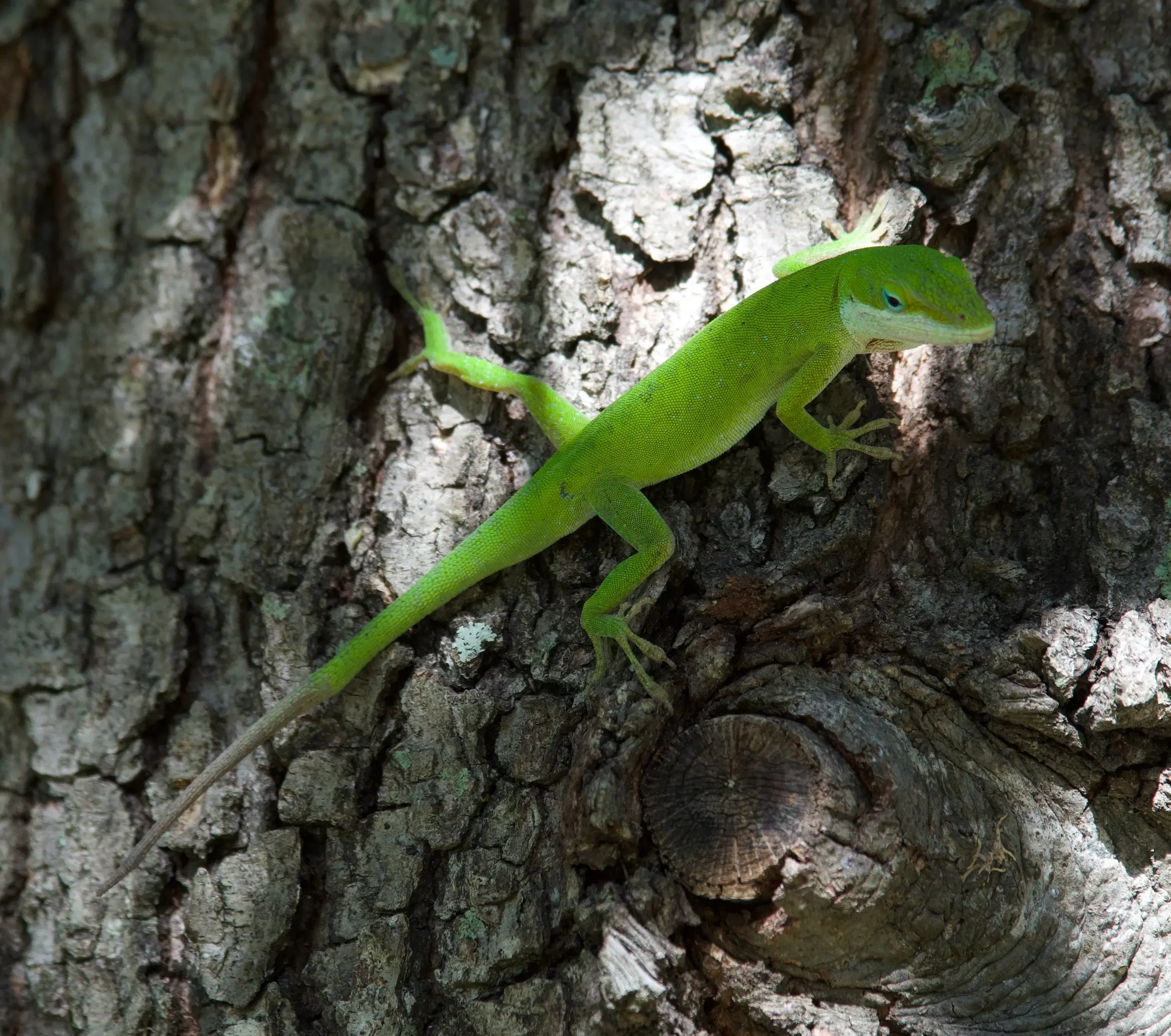
Green Anole.
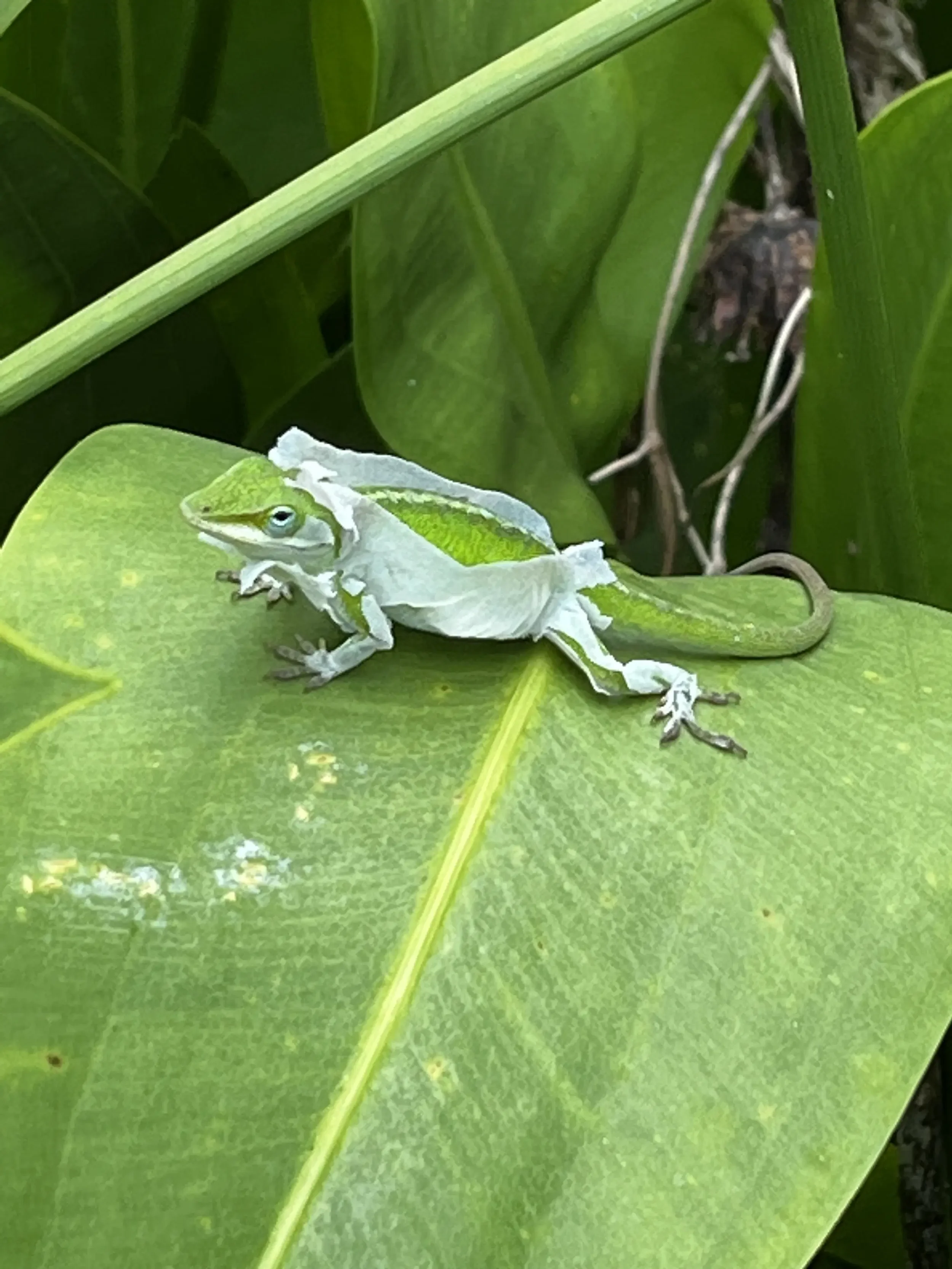
Green Anole Molting.
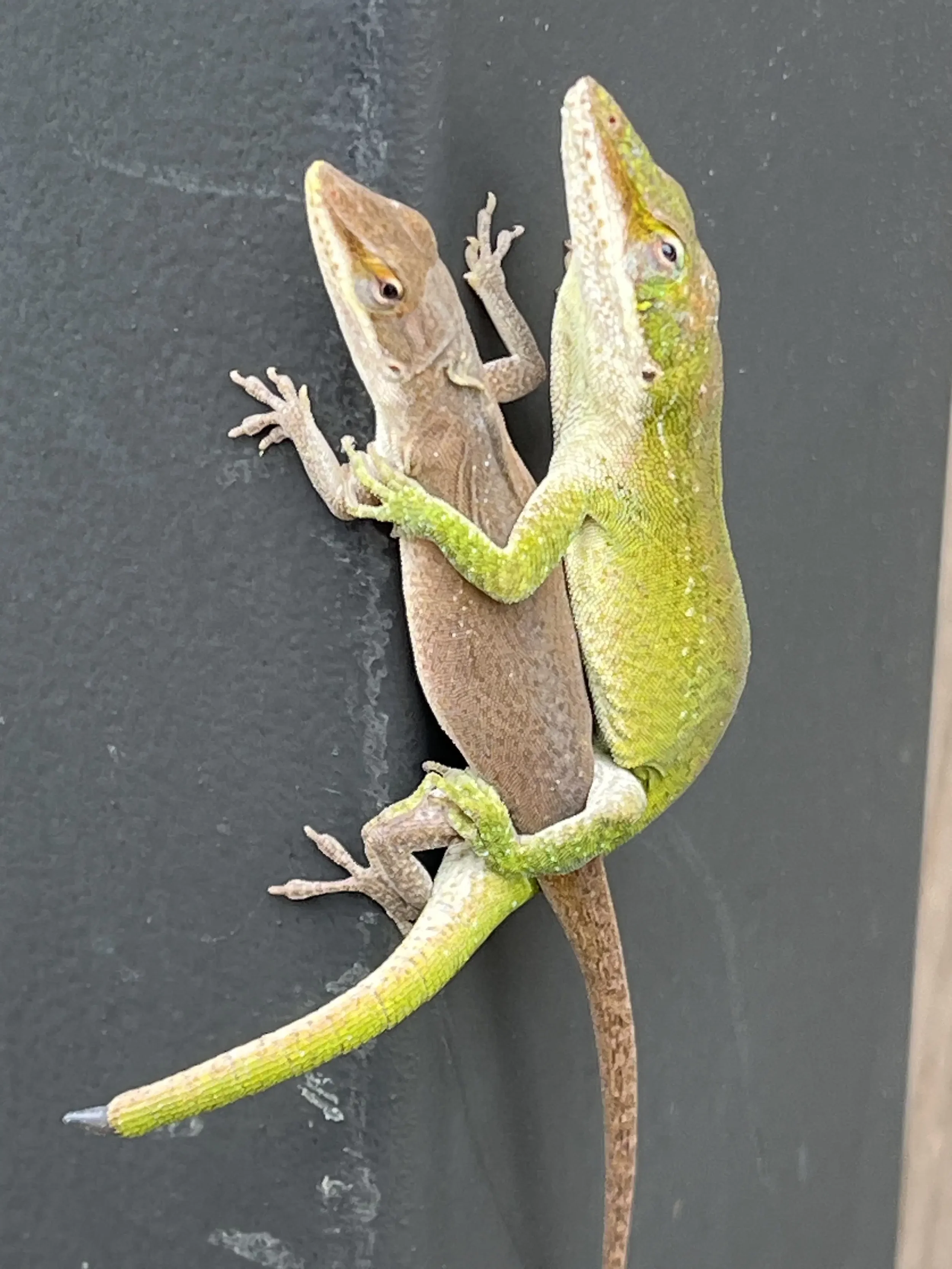
Green Anoles Mating + Color Variation.
You might encounter two other lizard species in the preserve: the Ground Skink and the Five-lined Skink. Skinks are low-slung lizards that are almost always on the ground; they don’t usually climb into vegetation. They have rather small, short legs and their scales are very fine and smooth, giving them a shiny appearance. The ground skink (also called little brown skink) is a shiny warm brown color and is small and slender, reaching about 4 to 5 inches in length, including the tail. Five-lined skinks can get much larger (up to about 8 or so inches long) and as adults have thicker bodies. Juvenile five-lined skinks have iridescent blue tails!
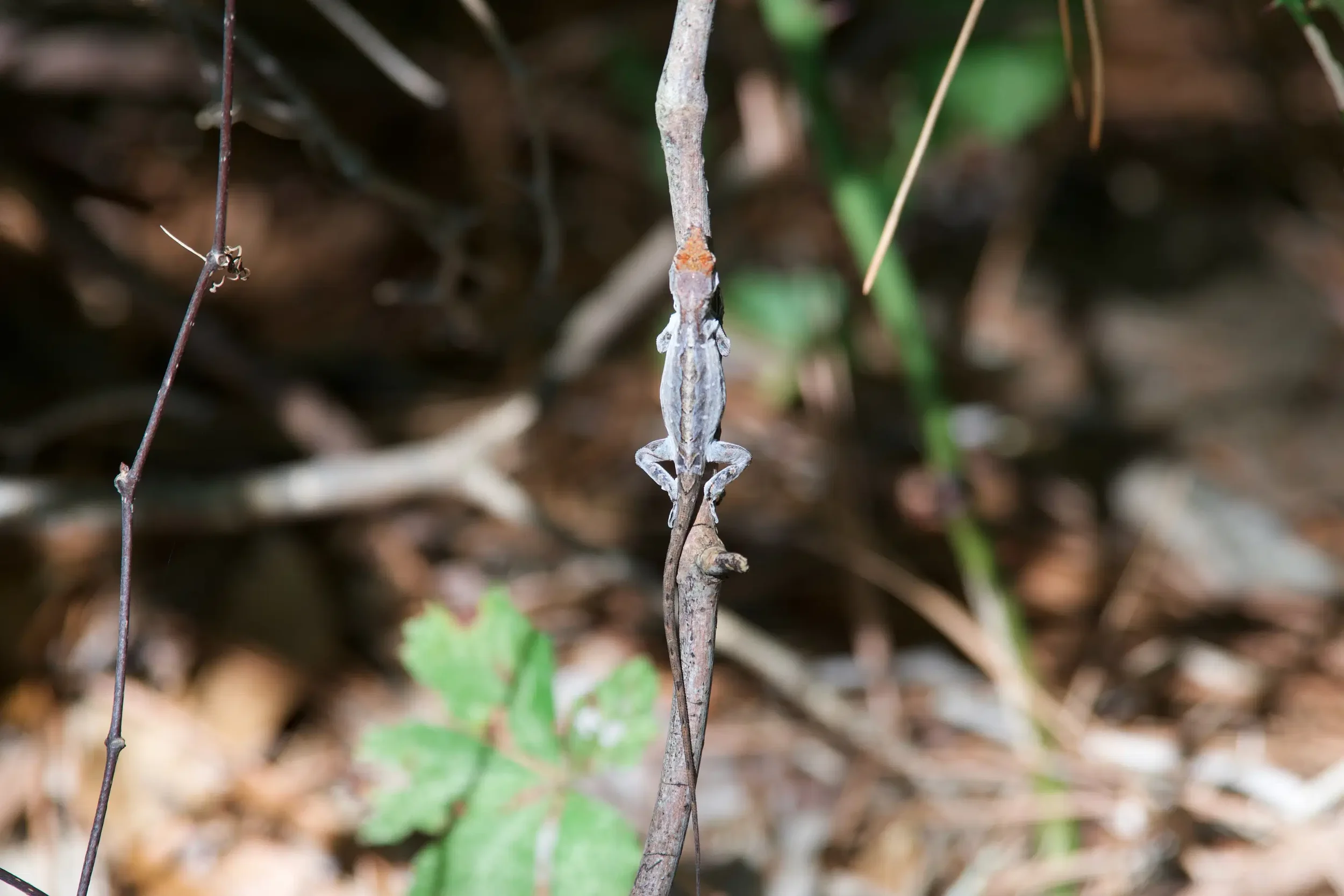
Brown Anole.
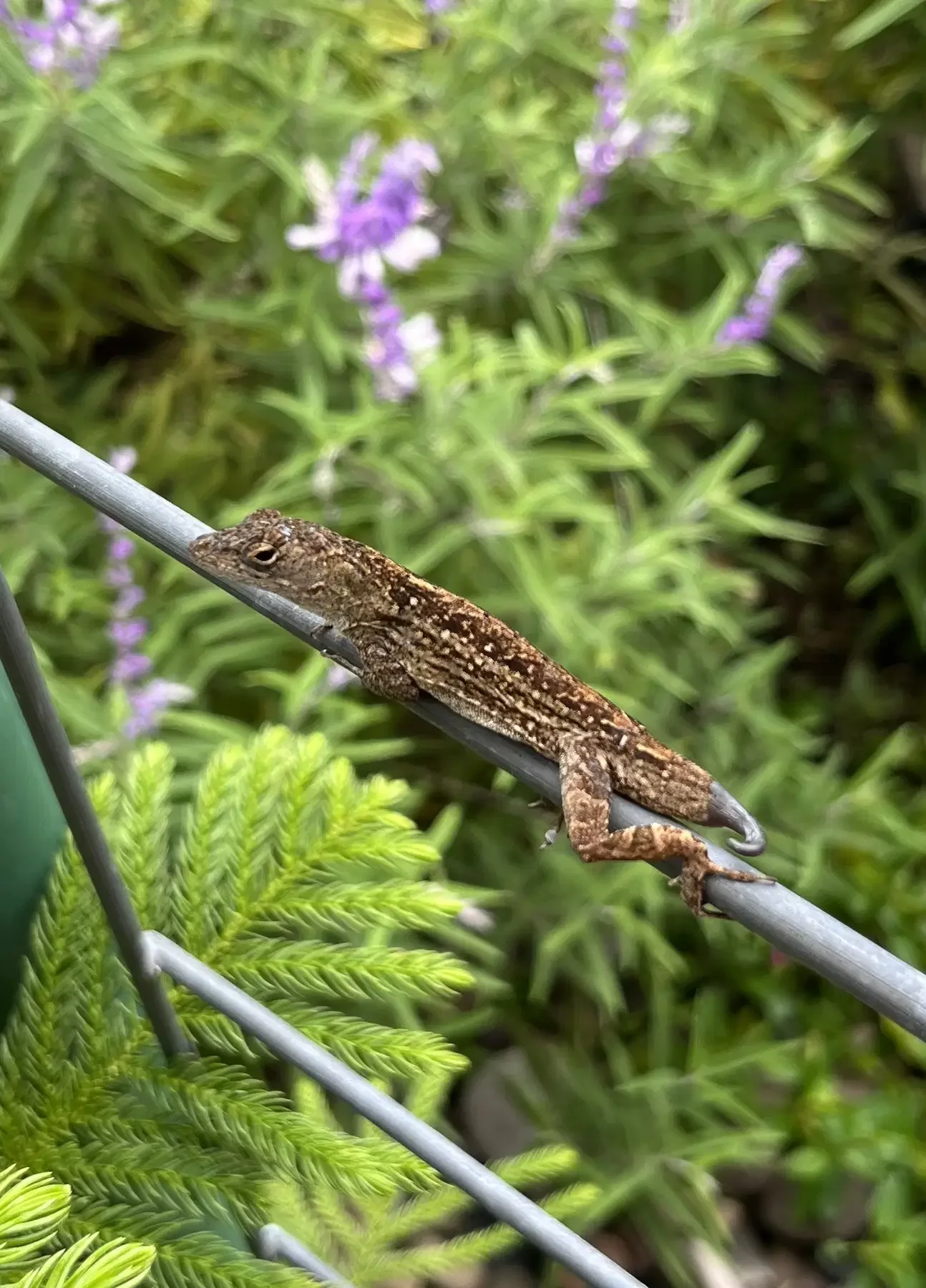
Brown Anole with a Broken Tail.
Box Turtles
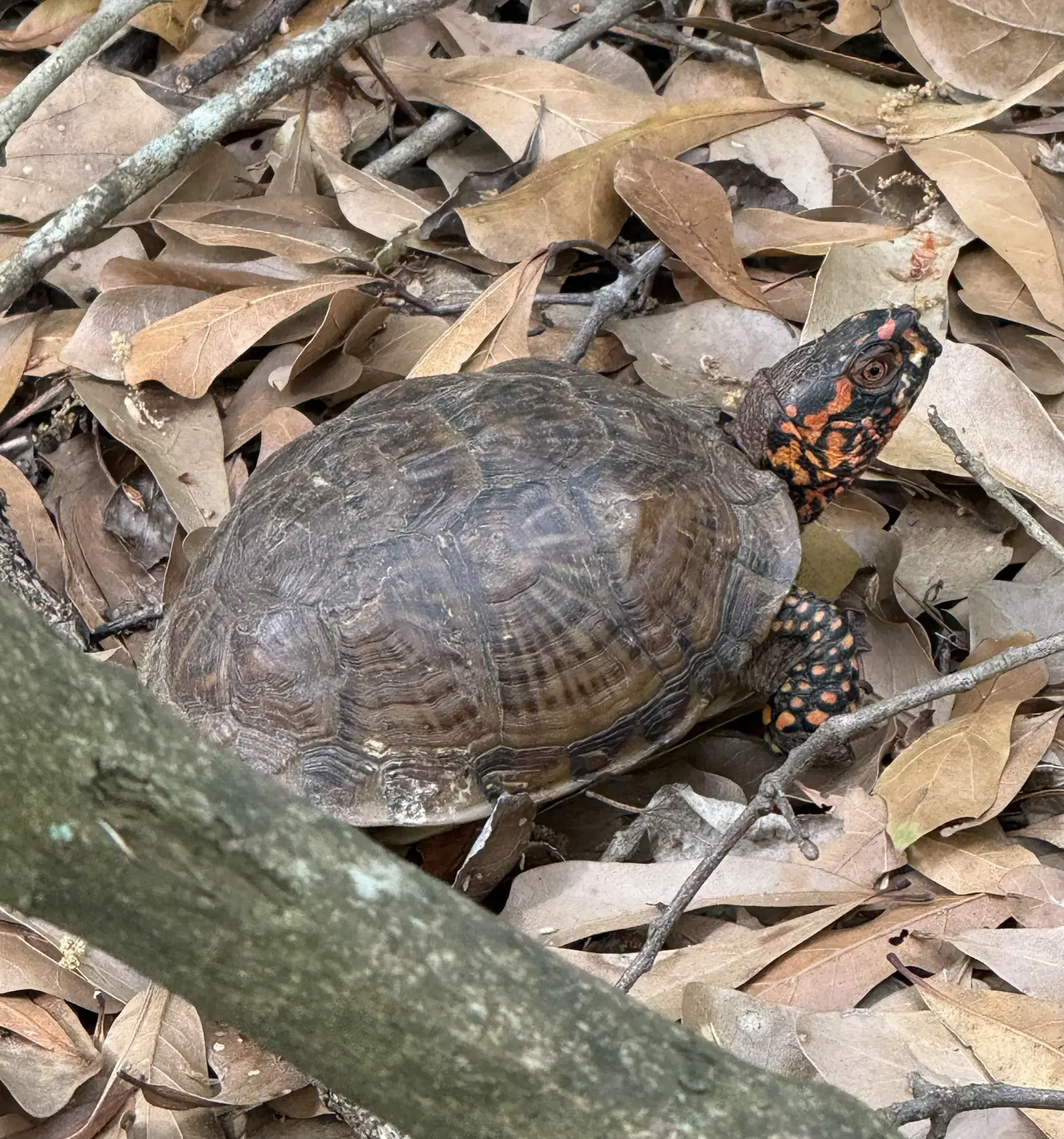
Box turtles are really fun to see in the preserve. Being the same color as the ground, they are hard to spot unless they cross the path in front of you, or you hear a crunching sound as they move through dry leaves. Box turtles are terrestrial and do not live in water. Box turtles are a woodland species that does need some moisture. In the preserve you might see one drinking or cooling off in the little ponds along the path during very hot or dry periods. However, they are very poor swimmers and will drown in deep water. Box turtles have high, domed shells and can close their front and rear plastron (bottom part of the shell) when they are disturbed (thus their name). Other turtles in Houston, such as the red-eared slider or snapping turtles, have much more streamlined, less domed shells and webbed feet adapted for swimming, not for stumping about on the ground. The aquatic turtles spend most of their time in bodies of water, only occasionally venturing onto land (usually to lay their eggs). Aquatic turtles are not typically seen in the preserve.
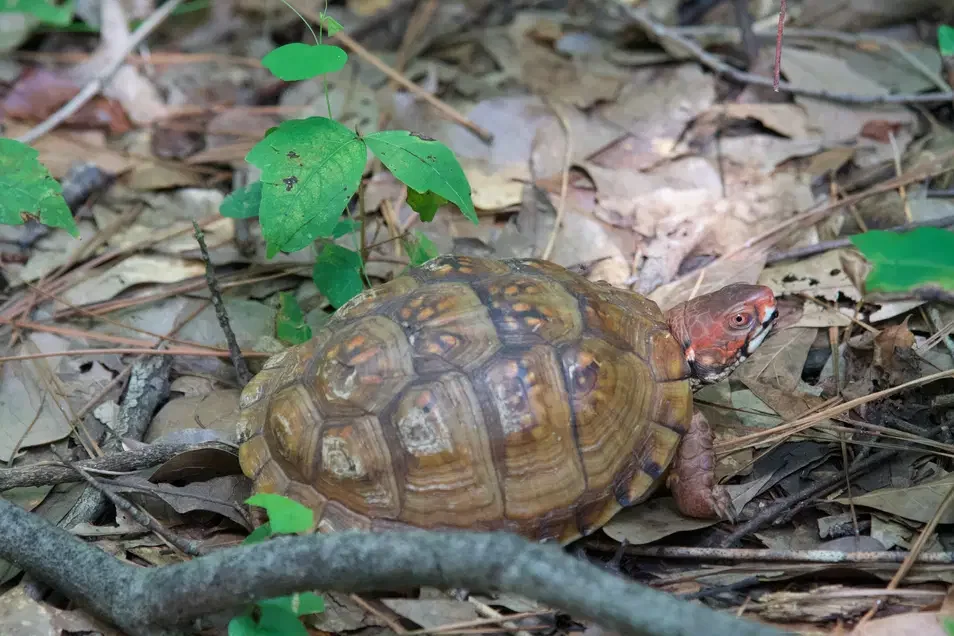
Ornate Box Turtle.
In winter, you won’t see box turtles in the preserve because like many reptiles, they go into a state of dormancy called brumation. This is a natural, hibernation-like state in reptiles characterized by inactivity, low metabolism, and lack of appetite. Brumating reptiles may emerge during warm spells to drink water, and they can even grow in this state.
Once the weather warms and the turtles wake in the spring, they are very hungry. Box turtles are omnivores and eat worms, beetle grubs, crickets and other insects, as well as mushrooms, greens, and berries.
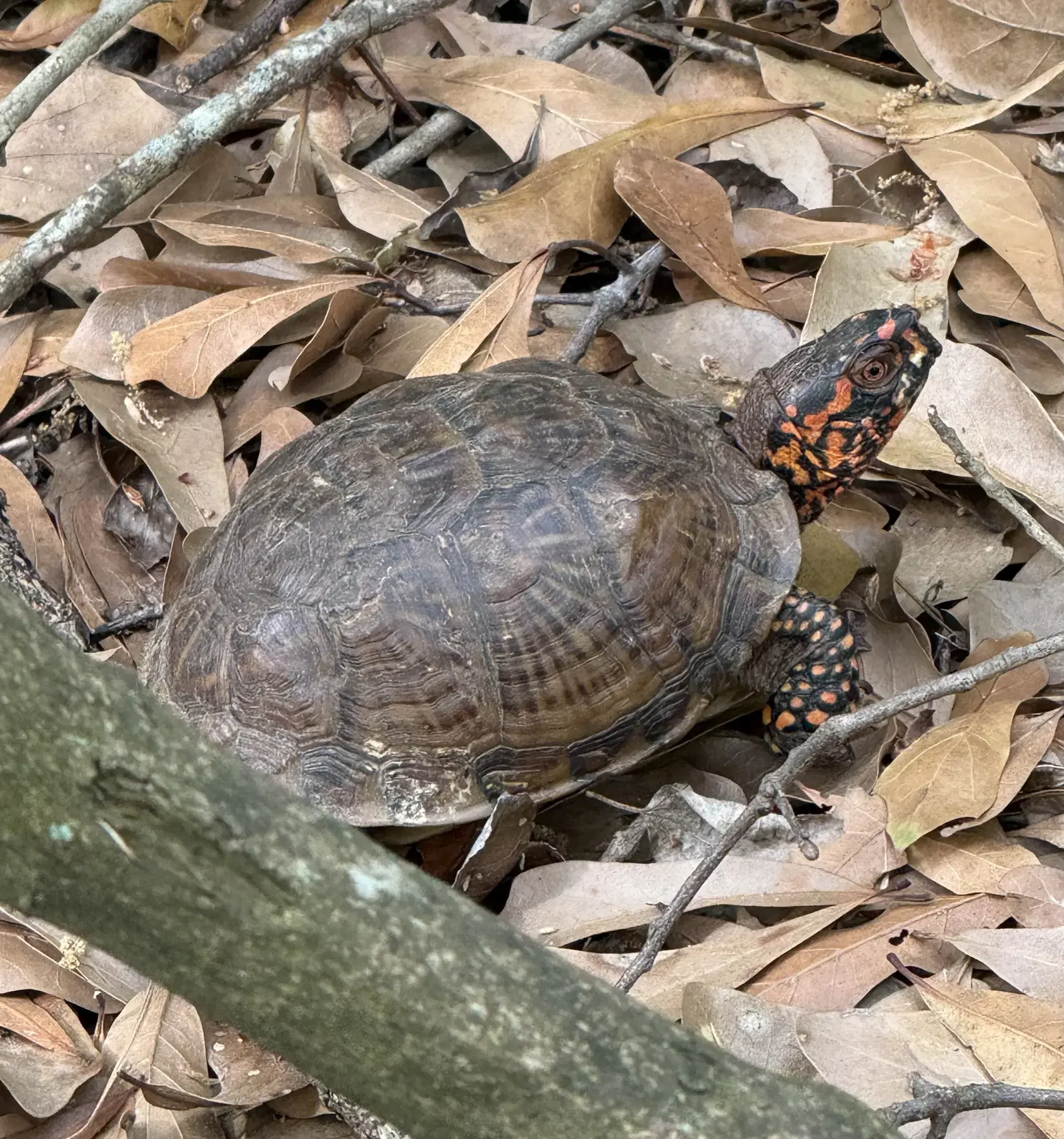
Three-toed Box Turtle.
If you are lucky enough to spot one of our box turtles, be sure to take the time to notice their boxlike shells. Two species occur in the preserve: the Three-toed Box Turtle, with a plain brown shell, is more common. Occasionally you may encounter an Ornate Box Turtle. This species has a darker shell patterned with yellow to orange splotches, blotches, and streaks. There is even evidence that they can hybridize, so it’s possible that we might have some hybrids.
Box turtles can be very long-lived, some reaching over 50 years old. They need to live someplace where their predators are managed or non-existent. Fortunately for our box turtles, the resident Great Horned Owls, which love to feast on rats and raccoons, keep the nature preserve a safe zone for them.
Please DO NOT touch or move the box turtles!!!
Snakes
Snakes are not commonly seen in the nature preserve, but they are there too. Most are non-venomous, but in 2024 a Coral Snake was seen several times. Coral snake venom is dangerous, but these snakes are timid and have very small mouths, so unless they are handled, they are harmless and will quickly slither away. Most snake sightings are of non-venomous species such as Ribbon Snakes, Garter Snakes, and the fascinating Eastern Hog-nose Snake. Unfortunately, the splotched pattern of the hog-nosed snake causes many people to mistake it for a copperhead or other viper, but they are completely harmless. However, they have a fascinating defense behavior. If disturbed, they will hiss as they spread and flatten the skin behind their head so that they look a bit like a cobra. If this menacing behavior doesn’t work to scare off a potential predator, they will play dead, often flipping onto their back.
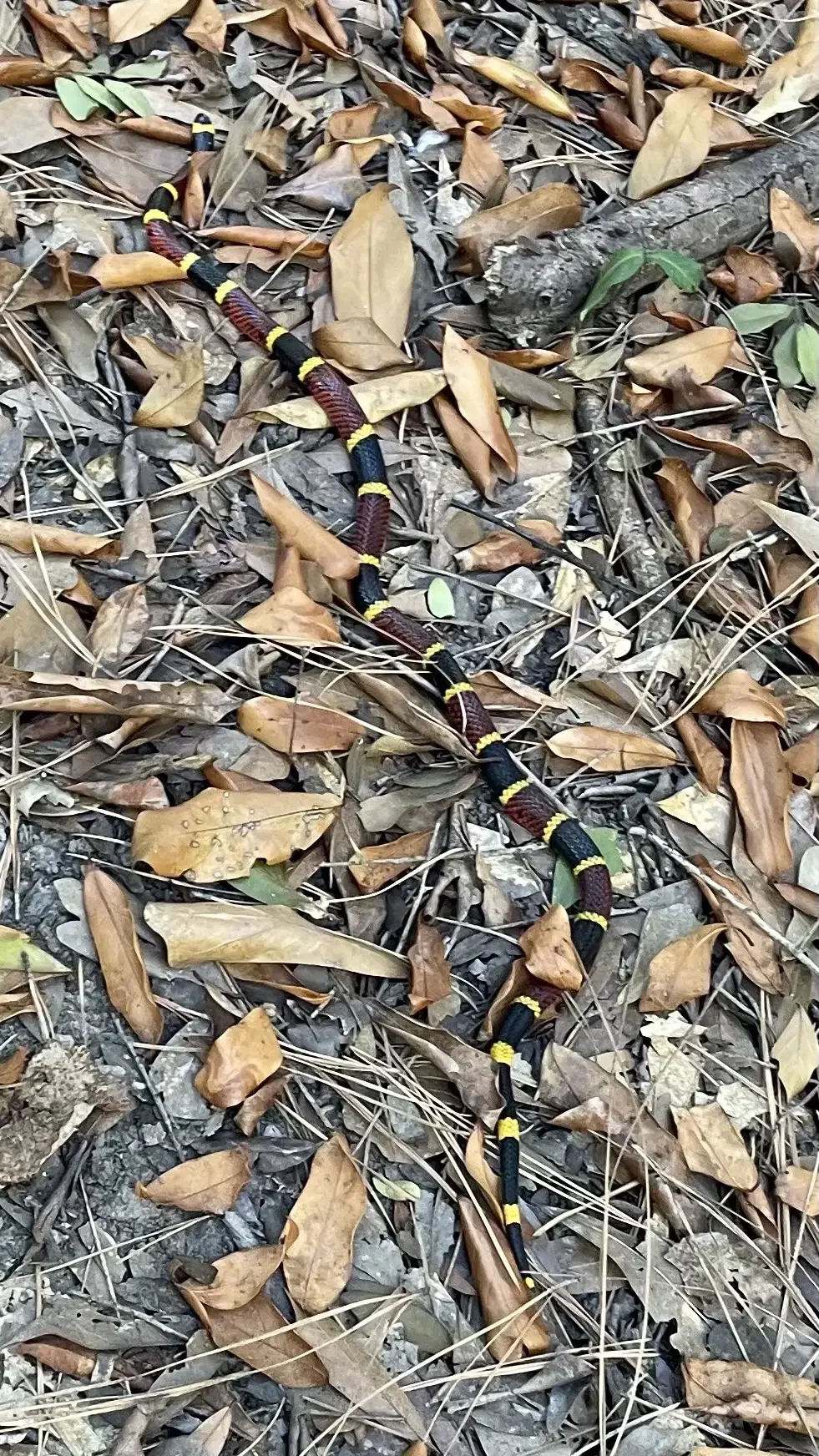
Coral Snake - "Red & Black is a friend of Jack, but Red & Yellow kills a Fellow"
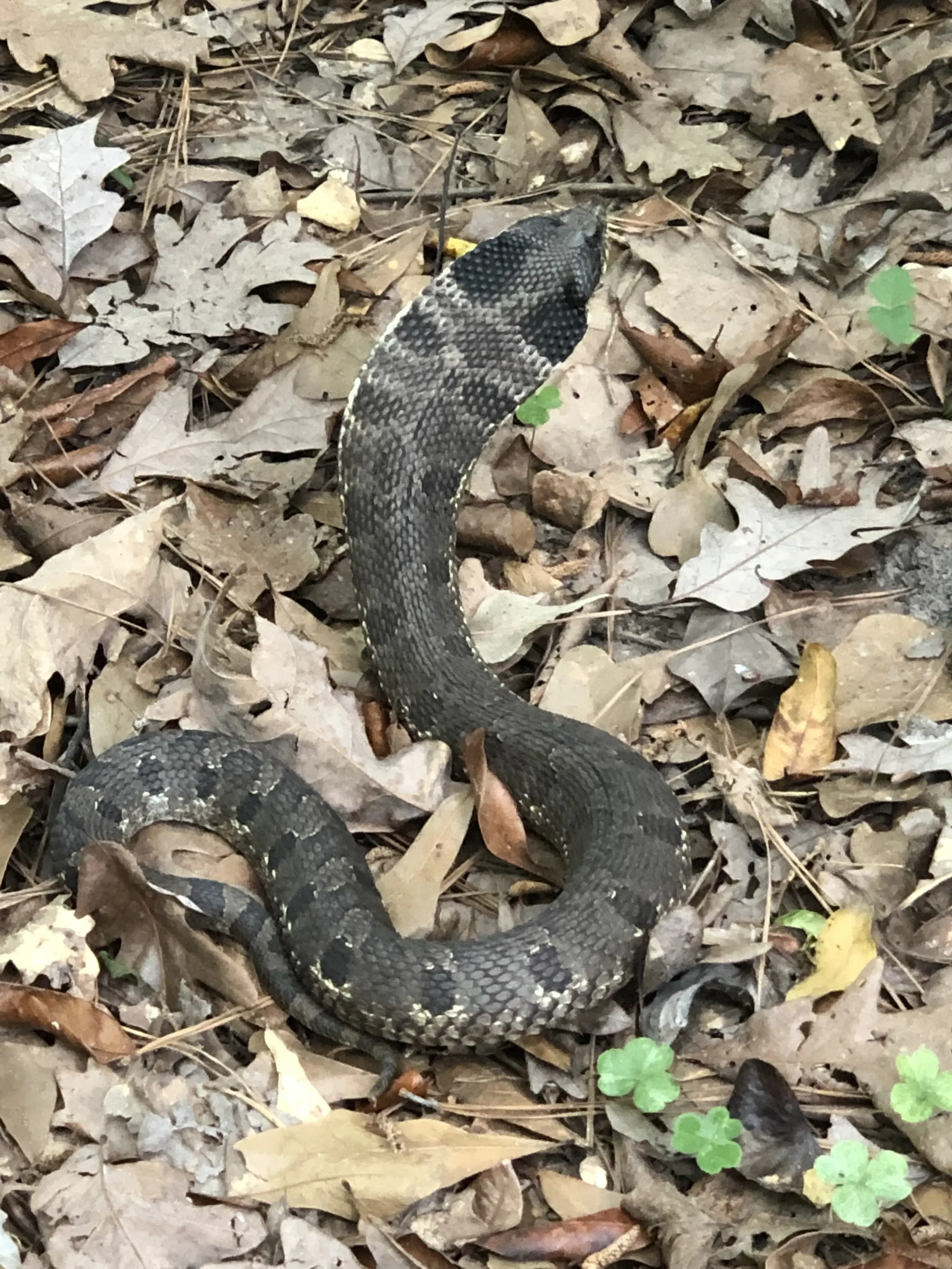
Eastern Hognose Snake.
Please do not touch or harass any snake that you see. Even non-venomous species can bite – and in any case, you are more likely to hurt them than they are to hurt you. Just enjoy the chance to see these amazing and very beneficial creatures and let them go their way.
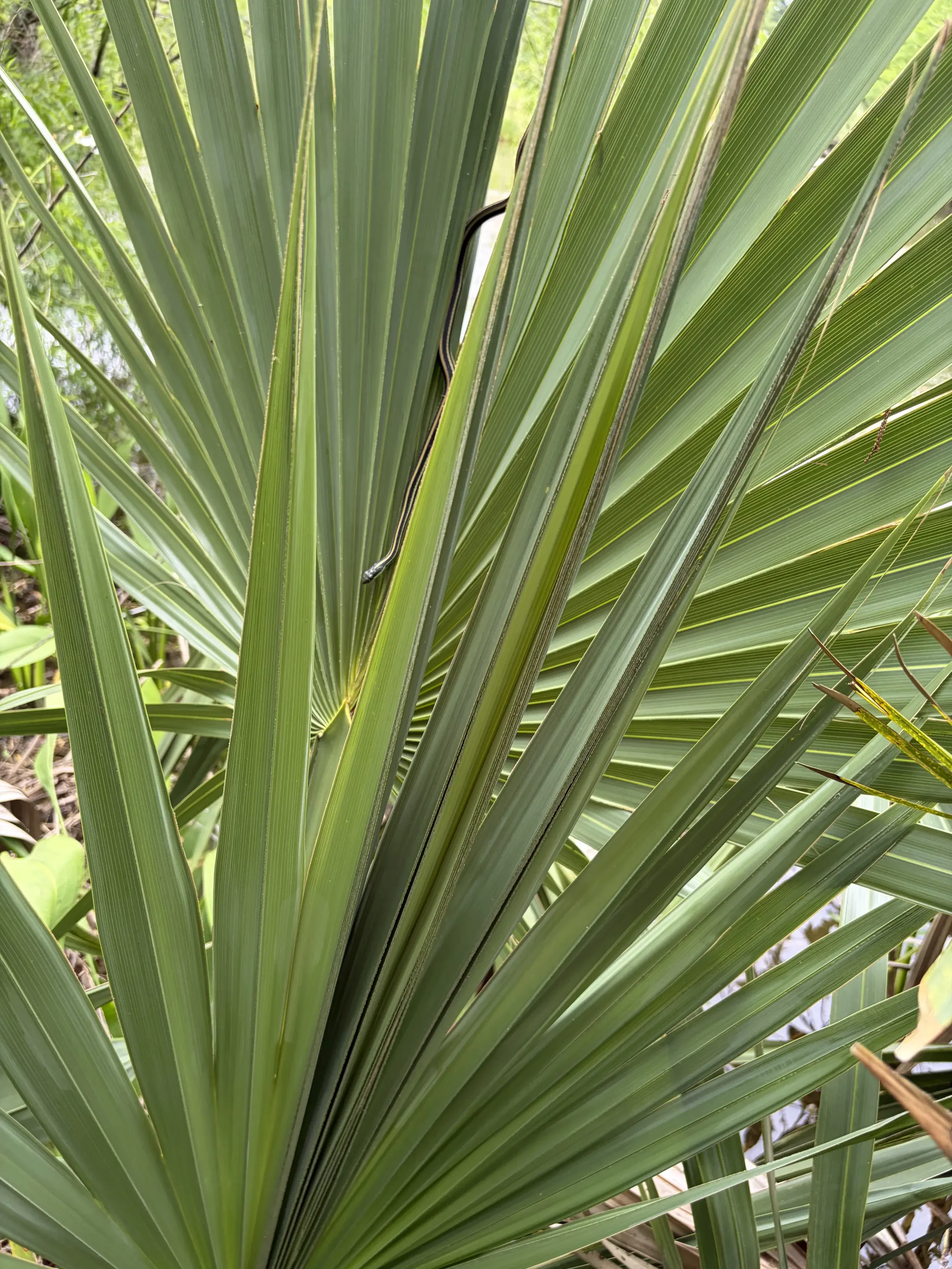
Ribbon Snake on Palmetto.
Amphibians
Amphibians include frogs, toads, and salamanders. Most amphibians are associated with moist or wet habitats, so because there is no natural water source in the preserve, we don’t see many amphibians there. However, our native Green Tree Frog (Hyla cinerea) only uses water to breed and MAY occasionally be spotted in the preserve. These frogs have smooth green skin that often looks almost oily, with a thin white line along their sides. Their toes are not webbed like those of aquatic frogs, but have little pads at the tips, an adaptation for climbing. These frogs are nocturnal; during the day they mostly hunker down on leaves, relying on their green color for camouflage. On wet days and especially wet nights, they become more active and can be quite noisy. During the breeding season, males make “advertisement calls” to attract females. This call is a loud, abrupt, nasal honk or bark emitted about once a second, and is sometimes described as sounding like a cowbell.
Frogs have long been a symbol of personal growth, renewal, and transformation, because of their continuous change on their journey from egg, through the tadpole stage, to adult. They are also known as "biological barometers" because they often increase their croaking before rain.
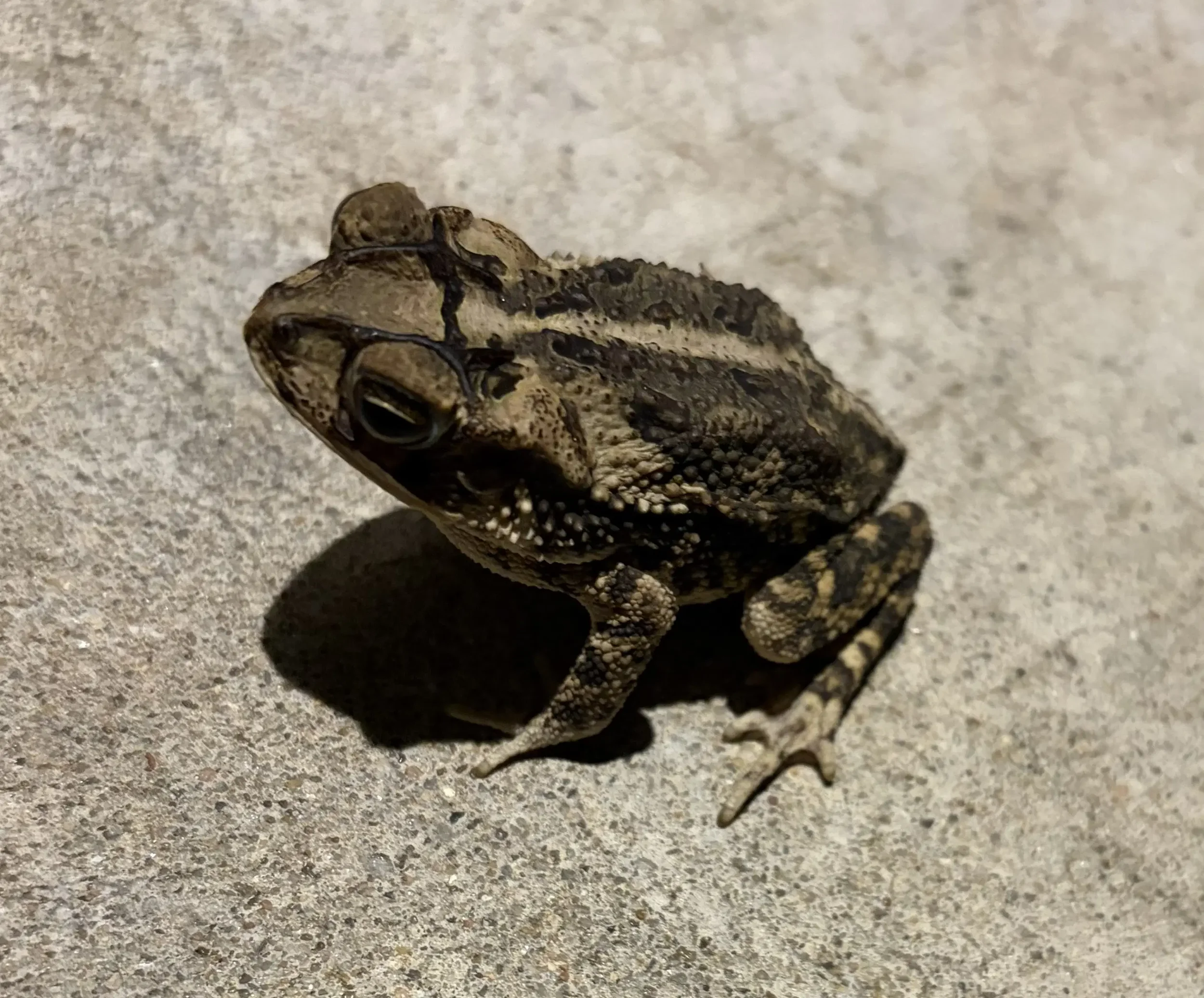
Gulf Coast Toad.
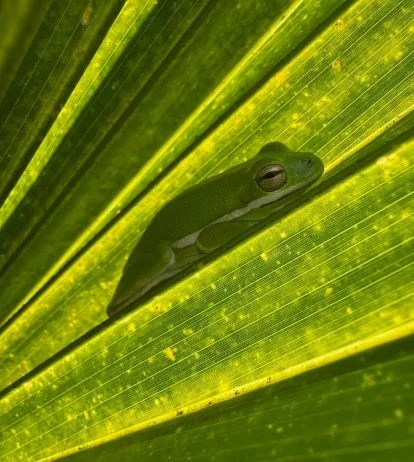
Green Tree Frog on Palmetto.
The Gulf Coast Toad, also known as the Coastal Plains Toad (Incilius nebulifer), is a widespread species found along the gulf coast of Mexico from as far south as Veracruz all the way north to Mississippi in the United States. It occurs in a wide range of habitats, both natural and human-altered: coastal prairies, barrier beaches, towns, etc. These toads are "urban survivors," often found in yards. They have bumpy, dark skin, a light-colored stripe down their back, and are very noisy during and after heavy rain, making a trilling sound. They spend most of their time on land, hiding under stones or vegetation during the day and coming out to hunt beetles and beetle grubs, moths, and other insects during the night. Truly a gardener’s friend, they eat all sorts of pest insects. They grow to 2.5”- 4” and commonly live 3 -5 years.
Breeding takes place in various kinds of ephemeral pools, including roadside gutters and irrigation ditches. Males and females will remain together in “amplexus” (a love embrace) for hours at a time, the male fertilizing the long slimy strings of eggs released by the female. The tadpoles are small and black, and develop very quickly, emerging from the water as tiny black toadlets (they need to complete their metamorphosis before their watery “nest” dries up). Most other frogs, which use more permanent bodies of water in which to breed, spend much longer and grow much bigger during the tadpole stage.
Another “toad” you may hear but will probably not see in the preserve is the Narrow-mouthed Toad (not a true toad, but a small, dark brown, smooth-skinned species in the family Microhylidae). They are very hard to spot, but their distinctive call, reminiscent of the baa-ing of a sheep, is frequently heard in rainy periods.
INaturalist
If you see these or other reptiles and amphibians during your visits to the preserve, please take pictures and post them on iNaturalist. We would love to know about any other species you see there. But, the Friends Group kindly asks you not to pick up or move ANY animal at the nature preserve. In addition to being better for the animal’s well-being to leave it in place, it is a violation of the City of Houston’s Nature Preserve Ordinance to remove animals from the preserve.
The City’s Nature Preserve Ordinance states:
Sec. 32-123:
"No person shall remove any wildlife from the preserve, or release, abandon, place, bury, or otherwise dispose of any live animal, carcass, or remains of an animal in the preserve ..."
Sec. 32-127. - Penalty for article violations:
"The violation of any provision of this article is hereby declared to be unlawful. Any person who violates the terms and conditions of section 32-123 and 32-126(b) of this article shall be deemed guilty of an offense and, upon conviction thereof, shall be punished as provided in section 1-6 of this Code. Each violation shall constitute and be punishable as a separate offense." (Ord. No. 2022-812, § 2, 10-12-2022)
Enjoy your time in the nature preserve and keep your eyes peeled for these fascinating animals with whom we share the planet.